
President ECOSF Highlights Regional Science Cooperation at Panel Discussion and Closing Ceremony of 2nd China-Pakistan Symposium
Islamabad, May 19, 2026: Prof. Seyed Komail Tayebi, President ECOSF participated as an invited panelist in the Panel Discussion and Closing Ceremony of the 2nd China-Pakistan Symposium on Early Warning for Hydrological and Geological Disasters, held at the National Disaster Management Authority (NDMA), Islamabad.
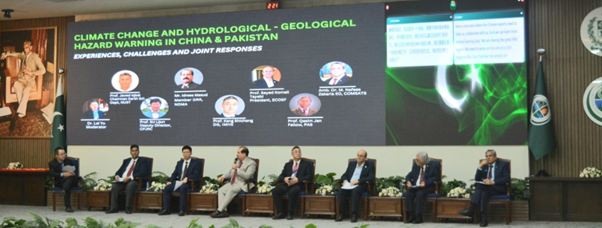
The panel discussion was held under the theme “Climate Change and Hydrological-Geological Hazard Warning in China and Pakistan: Experiences, Challenges, and Joint Responses.” The session brought together senior representatives of NDMA, academia, researchers from both Pakistan and China to deliberate on the growing risks of climate-induced hydrological and geological hazards and the need for stronger joint responses.
Speaking during the panel discussion, Prof. Tayebi emphasized that the China-Pakistan experience in early warning is significant not only for its scientific and technical value, but also as a successful model of institutional cooperation. He highlighted the China-Pakistan Joint Research Centre on Earth Sciences (CPJRC) as an example of how scientific cooperation can move beyond formal agreements and generate practical outcomes in research, capacity building, and disaster-risk preparedness.
Prof. Tayebi noted that many ECO Member Countries face common climate-related and geological hazards. He underscored the need to leverage the CPJRC platform and gradually expand its benefits to the wider ECO region by adapting the China-Pakistan cooperation model to different regional geographies, including mountain areas, river basins, drylands, seismic zones, and vulnerable transport corridors.
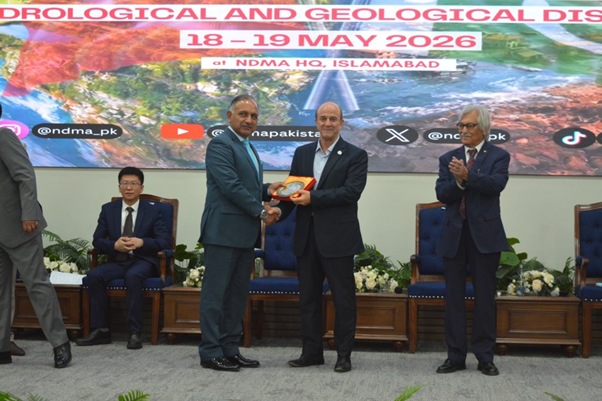
During the closing ceremony, Prof. Tayebi congratulated all the partner organizations for successfully organizing a highly relevant and timely symposium. Prof. Tayebi concluded that resilience to climate change is directly linked to economic resilience and stability.