
President ECOSF Participated in the Conference on the Straits of Hormuz: Legal and Economic Challenges, Hosted by University of Tehran
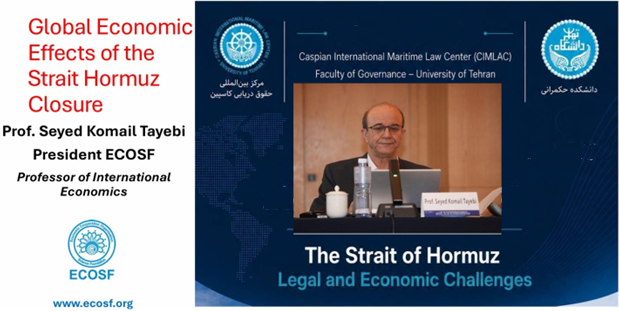
May 13, 2026 – Prof. Dr. Seyed Komail Tayebi, President ECOSF, participated in the conference on “The Straits of Hormuz Legal and Economic Challenges,” organized by the Caspian International Maritime Law Center (CIMLAC) at the Faculty of Governance, University of Tehran.
In his presentation, Prof. Tayebi explained that a potential closure of the Strait of Hormuz could trigger cascading global economic consequences described as a “tsunami effect” on energy flows and supply chains. As a route carrying nearly 20% of the world’s oil, even the threat of disruption creates immediate psychological and financial reactions in global markets, raising oil prices, insurance premiums, and shipping costs, while setting off a domino effect across international trade and financial systems. He further noted that this vulnerability exposes global supply chain fragility, disrupts industries worldwide, weakens import-dependent economies, and forces central banks into difficult policy trade-offs, with trade growth projections for April 2026 falling to 1.5%–2.5% and potential losses reaching $20 billion per day.
President ECOSF added that the broader impact of such disruption extends to households and national economies, as rising fuel and energy costs increase inflationary pressure and deepen macroeconomic stress in vulnerable countries, including Iran, where inflation and unemployment have pushed the Misery Index to record levels. The crisis highlights the structural weakness of a global system heavily dependent on a single energy chokepoint, while also accelerating long-term transformation as countries pursue energy diversification, strengthen supply chain resilience, and invest in the energy transition.
Looking ahead, he mentioned, the future points toward a gradual shift to more decentralized, resilient, and secure energy and trade systems, as nations increasingly prioritize strategic autonomy and reduce dependence on vulnerable maritime routes.