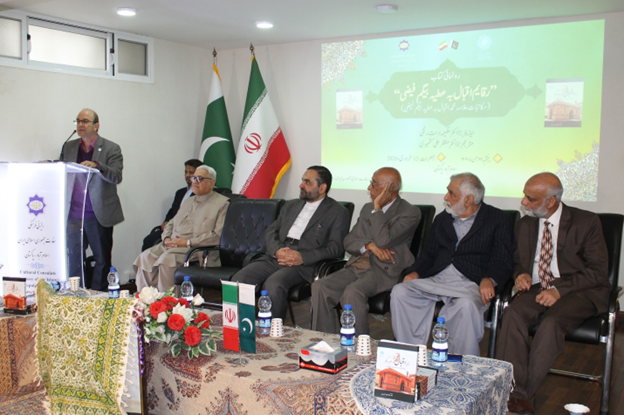
The President of the ECO Science Foundation participated in the book launch ceremony of the valuable work Iqbal’s Letters to Atiya Begum, a collection of correspondence between Allama Iqbal and Atiya Begum Faizi
Thursday, February 12, 2026 – The ceremony was held on Thursday, February 12, 2026, and was hosted by the Cultural Consulate of the Embassy of the Islamic Republic of Iran in Islamabad in collaboration with the ECO Cultural Institute.
This cultural event, aimed at deepening literary ties among regional nations and revisiting the intellectual heritage of Allama Iqbal Lahori, marked an important step toward strengthening regional cultural integration.
According to the ECO Cultural Institute’s Public Relations Office, a video message from Dr. Mohammad Hassan, President of the ECO Cultural Institute, was broadcast during the opening session. Emphasizing Allama Iqbal’s transnational significance, he stated:
“The collection of Iqbal’s letters is not merely a literary work but a strategic document for a deeper understanding of intellectual currents and human bonds across the ECO cultural landscape. Publishing such works in various regional languages is our primary mission in the path toward unified identity-building and cultural cohesion.”
He also reaffirmed the Institute’s continued support for original and influential research in the field of Iqbal Studies.
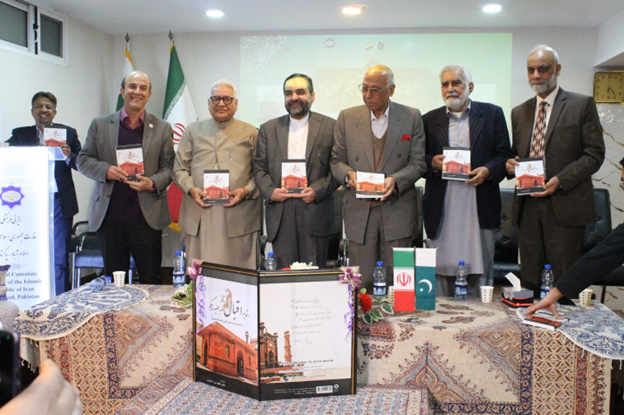
The session continued in the presence of other senior ECO officials and distinguished academic figures, including Prof. Seyed Komail Tayebi, President of the ECO Science Foundation, and Mr. Majeed Meshki, Cultural Counselor of the Embassy of the Islamic Republic of Iran in Islamabad.
In his address, Prof. Tayebi stated that Allama Iqbal regarded science as a sacred pursuit that complements faith and strengthens the human self (Khudi). He explained that Iqbal considered the study of nature a form of worship and believed that humanity, as God’s vicegerent, must utilize knowledge and technology to understand, master, and transform the world responsibly.
He further elaborated that scientific observation reveals the signs of God, with science providing material power while religion offers moral and ethical guidance. He cautioned that science without spirituality leads to materialism and potential destruction, emphasizing the necessity of harmony between reason and revelation.
In the field of political economy, Prof. Tayebi noted that Iqbal linked economic justice with spiritual growth. He rejected both capitalism and atheistic communism and advocated for an Islamic economic system grounded in social justice, aimed at enabling the full development of the human self.