
UNESCO, COMSATS and ECOSF Launch Regional Webinar Series with Session on Bioethics and Human Rights
The ECO Science Foundation (ECOSF), in partnership with UNESCO and COMSATS, launched the joint UNESCO–COMSATS–ECOSF Regional Webinar Series on 9 September 2026. The inaugural session focused on UNESCO initiatives on bioethics and human rights.
The webinar opened with remarks by distinguished organizational heads and followed by technical presentations.
Dr. Fuad Pashayev, UNESCO Representative in Pakistan, welcomed the launch of the series and said that science must respect and serve the communities in the best possible way.
Dr. Dafna Feinholz, Chief of the Bioethics and Ethics of Science and Technology Section, UNESCO Headquarters, introduced UNESCO’s work on bioethics and noted that the challenge is not technology itself, but how it is developed and used.
Prof. Seyed Komail Tayebi, President ECOSF, stressed that innovation must be balanced with rights, privacy and informed consent, and reaffirmed ECOSF’s commitment to promoting ethical science across the ECO region.
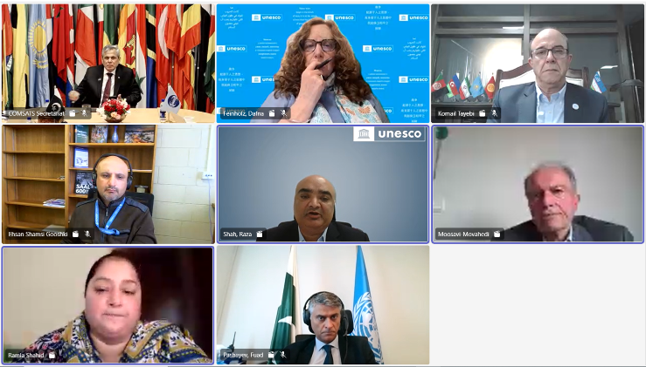
Ambassador Dr. Mohammad Nafees Zakaria, Executive Director, COMSATS, emphasized that ethical principles must be translated into practical institutional mechanisms, and highlighted the value of South–South cooperation in this area.
Dr. Ehsan Shamsi Gooshki, Coordinator, Me dical Ethics Program, Monash University, presented ethical challenges in medical research and clinical practice, with emphasis on informed consent and patient rights.
Prof. Ali Moosavi Movahedi, UNESCO Chair on Interdisciplinary Research in Diabetes, University of Tehran, spoke on the ethical responsibilities of researchers in interdisciplinary biomedical research.
Prof. Dr. Ramla Shahid, Director ORIC, Kohsar University Murree, highlighted the role of universities in embedding ethics review and research integrity within their institutions.
The discussion reinforced a central message: scientific progress must remain responsible inclusive and people centred.