
ECOSF Presents Technical Perspective on Risk-Informed Green Transport Corridors at 2nd China-Pakistan Symposium
Islamabad, May 19, 2026: ECOSF contributed to the technical parallel session during the 2nd China-Pakistan Symposium on Early Warning for Hydrological and Geological Disasters held at NDMA, Islamabad. Mr. Khalil Raza, Program Manager – Energy & Climate at the ECO Science Foundation (ECOSF), delivered a technical presentation titled “Risk-Informed Green Transport Corridors for a Climate-Resilient ECO Region,” he emphasized the ECO region’s strategic importance as a bridge linking Asia, Europe, Central Asia, South Asia, the Middle East, and the Mediterranean. He noted, however, that these transport corridors pass through highly climate-vulnerable and hazard-prone areas, where threats such as glacial lake outburst floods, landslides, earthquakes, flash floods, extreme heat, drought, coastal risks, and Caspian Sea level changes can disrupt infrastructure and regional trade.
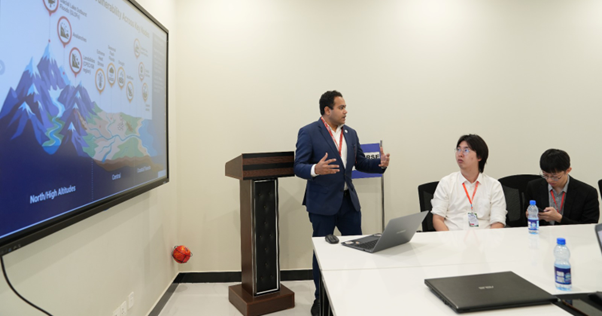
Mr. Raza stressed that green transport corridors must also be risk-informed, arguing that decarbonization and climate adaptation should go hand in hand to ensure resilient connectivity. He presented the idea of “Green Logistics + Risk Intelligence = Resilient Connectivity” as a framework for future corridor planning in the ECO region. This means that decarbonized transport systems, when guided by risk mapping and early warning, enable more reliable, adaptive, and disruption‑resilient connectivity. Mr. Raza called for stronger regional cooperation on multi-hazard early warning systems, green logistics, renewable-powered transport nodes, and climate-resilient infrastructure investment to support sustainable and resilient connectivity across the ECO region.