
ECOSF Co-organizes the “Best Practices in Education” Session at International Conference on Research and Practices in Education (ICRPE) 2026
Islamabad, 22 September 2026- The ECO Science Foundation (ECOSF) co-organized the “Best Practices in Education” session of the 9th International Conference on Research and Practices in Education (ICRPE 2026), held at Allama Iqbal Open University (AIOU), Islamabad, on 22 September 2026. The session brought together education leaders, institutional heads and sector experts to discuss innovative frameworks, inclusive practices and systemic advancements in the learning ecosystem. The session was moderated by Dr. Tahira Bibi of the Faculty of Education, AIOU.
Representing ECOSF, Mr. Khalil Raza, Program Manager delivered a talk titled “Beyond the Classroom: Innovative Approaches to STEM Education through Inquiry, Climate Action and Experiential Learning“. He highlighted the links between sustainability, climate literacy and capacity building in education, and stressed the role of regional cooperation and modern technological tools in building future-ready learning ecosystems.
Mr. Muhammad Irfan, Founder and Principal/CEO of Kingston School for Inclusive Education, shared grassroots implementation models and practical classroom-level interventions for mainstreaming inclusive education in schools. Mr. Ali Asghar, Director General of the National Commission for Human Development (NCHD), presented large-scale literacy initiatives and community-based non-formal education frameworks aimed at bridging educational gaps in remote and underserved areas.
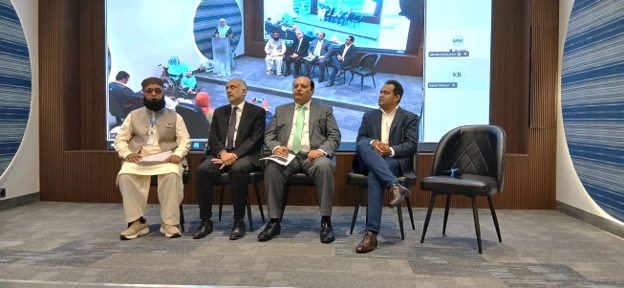
Mr. Bilal Aziz, Program Specialist at the Japan International Cooperation Agency (JICA) Pakistan, outlined international technical cooperation frameworks, bilateral education projects, and technical and vocational education and training (TVET) best practices supported by JICA in Pakistan. Dr. Shagufta Khanum, Vice President of VOICE Society for the Rehabilitation of Persons with Disabilities, Lahore, addressed strategies for barrier-free learning environments and the policy measures needed for the educational and social inclusion of persons with disabilities.
The session concluded with the following key recommendations:
- Integrate inquiry-based, experiential STEM learning linked to climate action into school curricula, backed by teacher training and regional cooperation.
- Mainstream inclusive education by equipping schools with practical classroom-level tools and trained staff, scaling up proven grassroots models.
- Expand community-based non-formal education and literacy programs to reach out-of-school children and adults in remote and underserved areas.
- Strengthen technical and vocational education and training (TVET) through international partnerships aligned with labour-market needs.
- Ensure barrier-free learning environments and supportive policies so that persons with disabilities have full access to education.