
President ECOSF attended the webinar on “Mathematics and Hope” for the International Day of Mathematics 2026
Friday, 13 March 2026 – UNESCO Headquarters, Paris, organized a webinar on “Mathematics and Hope” for the International Day of Mathematics 2026. Prof. Tayebi, President ECOSF, attended the event virtually.
The 2026 theme of the webinar, Mathematics and Hope, reflected the idea that mathematics, like hope, is one of humanity’s most universal assets. The speakers focused on the importance of Mathematics which enables a deeper understanding of reality, supports the development of shared frameworks and definitions, and contributes to solutions that serve the common good. Mathematics equips us to navigate uncertainty, build trust in knowledge, and imagine more inclusive and sustainable futures. Beyond driving scientific and technological progress, it also contributes to social cohesion and resilience.
At the opening session, Ms Lidia Brito, Assistant Director-General for Natural Sciences, UNESCO, said that by fostering collaboration, trust and mutual benefit, mathematical thinking encourages more equitable and cooperative societies. In line with its mandate, UNESCO supports students and educators worldwide in discovering mathematics as a tool for understanding, cooperation and hope.
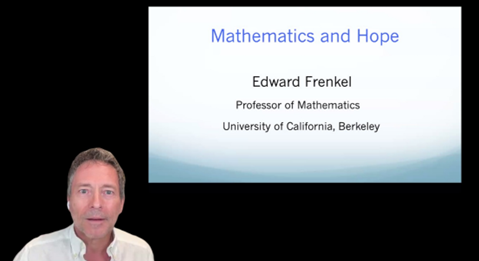
Professor Edward Frenkel, University of California, Berkeley, delivered a keynote lecture on mathematics and hope and said that mathematics unites us all, and every mathematical formula or theorem expresses a fundamental truth about nature and about ourselves. These truths are persistent, unchangeable, eternal. Prof. Frenkel added mathematics describes our inner, mental world. It gives us an objective, scientific approach to the study of the human mind.
The panelists of the session on “Hope and Mathematics” discussed that since its proclamation by UNESCO in 2019, the International Day of Mathematics has been celebrated annually to raise global awareness of the essential role that mathematics and mathematics education play in science, technology, societal well-being, and the achievement of the United Nations 2030 Sustainable Development Goals. Each year, a dedicated theme highlights a particular dimension of mathematics’ impact on society.
At the closing session, Dr. Shaofeng Hu, Director of the Division of Science Policy and Basic Sciences, UNESCO, delivered the vote of thanks.