
CECECO and ECO Science Foundation Hold Regional Webinar on Sustainable Transport and Electric Mobility in the ECO Region
Islamabad/Baku, 28 September 2026 — The ECO Science Foundation (ECOSF) and the Economic Cooperation Organization Clean Energy Center (CECECO) jointly organized a regional webinar titled “Sustainable Transport and Electric Mobility in the ECO Region,” bringing together policymakers, experts, and practitioners to discuss transport emissions, electric vehicle adoption, and the transition towards sustainable mobility across the ECO region.
The webinar, moderated by Ms. Nigar Shukurova from CECECO, addressed the growing importance of sustainable transport amid increasing mobility demand. Discussions focused on electric vehicle adoption, renewable energy, charging infrastructure, regulatory frameworks, and investment opportunities.
In his welcoming remarks, Prof. Seyed Komail Tayebi, President ECOSF, highlighted the importance of regional cooperation, sharing experiences, common standards, and capacity building to advance sustainable transport and electric mobility. He also highlighted the region’s transport emissions, growing electric vehicle market, and opportunities for joint action among ECO Member Countries.
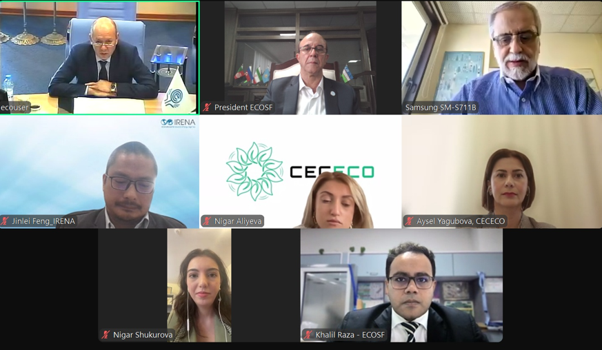
Ms. Aysel Yagubova, Executive Director of CECECO, underlined the position of integrating electric mobility with the broader clean energy transition. She emphasized the role of renewable energy, reliable electricity grids, energy storage, and charging infrastructure in supporting sustainable transport, reducing transport-related emissions, improving urban air quality, and strengthening energy security.
H.E. Ambassador Silapberdi Nurberdiyev, Deputy Secretary General of the ECO Secretariat, delivered special remarks on behalf of the Secretariat, emphasizing the role of sustainable transport and electric mobility in strengthening economic resilience, reducing environmental impacts, and promoting green innovation across the region. He also referred to the importance of regional cooperation and knowledge exchange among ECO Member Countries.
Mr. Jinlei Feng, Programme Officer for Policy Advice at the International Renewable Energy Agency (IRENA), presented a global perspective on policies for the electrification of road transport, addressing policy approaches and enabling frameworks for accelerating the transition.
Prof. Madjid Abbaspour, Professor at the Energy & Environment Group of Sharif University of Technology, discussed the regional perspective on scaling up electric vehicle adoption in the ECO region, highlighting key challenges and opportunities, including higher purchase cost, charging infrastructure gaps etc.
Mr. Khalil Raza, Programme Manager – Energy & Climate at the ECO Science Foundation (ECOSF), presented an analysis of transport emissions and electric vehicle trends across the ten ECO Member Countries. He highlighted the region’s growing EV-market and outlined key policy priorities, including clean energy integration, predictable incentives, local manufacturing, and sustainable financing to accelerate electric mobility.
The webinar stressed the significance of harmonizing standards, developing interconnected charging networks along regional transport corridors, and strengthening cooperation in research, technology, and knowledge exchange.
The event provided a platform for sharing experiences, identifying common challenges, and exploring practical opportunities for regional cooperation in sustainable transport and electric mobility, reaffirming the importance of collaboration in supporting a cleaner, more connected, and sustainable ECO region.
At the end, the vote of thanks was delivered by Prof. Tayebi and Ms. Aysel Yagobova.