World Water Day 2026 Highlights Urgent Need for Climate-Resilient and Gender-Responsive Water Governance in Pakistan
Islamabad, 16 June 2026 — The ECO Science Foundation (ECOSF) partnered with UNESCO, UNICEF, WHO, UNDP, the UNESCO Water Chair at COMSATS University Islamabad, the Pakistan Council of Research in Water Resources (PCRWR), the Global Climate-Change Impact Studies Centre (GCISC) to co-organize the World Water Day 2026, held in Islamabad under the theme “Water and Gender.” The event brought together policymakers, United Nations agencies, researchers, development partners, and civil-society representatives to strengthen action on water security, climate resilience, and gender-responsive governance in Pakistan.
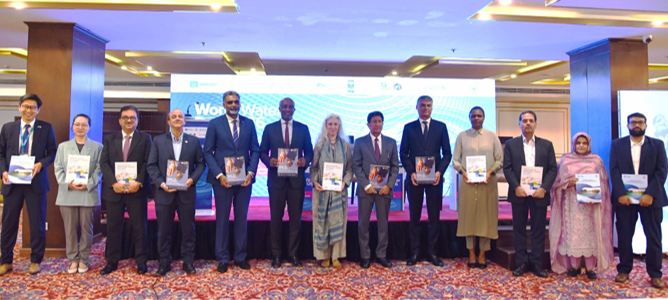
The event marked the launch of three major publications: the United Nations World Water Development Report 2026, the UN-Water Global Analysis and Assessment of Sanitation and Drinking-Water (GLAAS) 2025 Report, and the Guidelines for Science, Policy, Practice Interface for Achieving Water Security in Pakistan.
In his address, Mr. Mian Muhammad Mueen Wattoo, Federal Minister for Water Resources, underscored the severity of Pakistan’s water challenge, noting that per-capita freshwater availability has declined from more than 5,000 cubic metres at the time of independence to below 1,000 cubic metres today.
The discussions highlighted Pakistan’s increasing water stress, driven by rapid population growth, heavy dependence on agriculture, groundwater depletion, inefficient water use, pollution, and the growing impacts of climate change. A central focus of the event was the unequal burden borne by women and girls. Globally, women and girls spend an estimated 250 million hours every day collecting water — more than three times the time spent by men and boys. This burden affects their education, health, safety, livelihoods, and ability to participate in decision-making.
Mr. Mohamed Yahya, United Nations Resident Coordinator in Pakistan emphasized the importance of context-specific solutions, stating that water interventions should be inclusive, practical, and rooted in local knowledge.
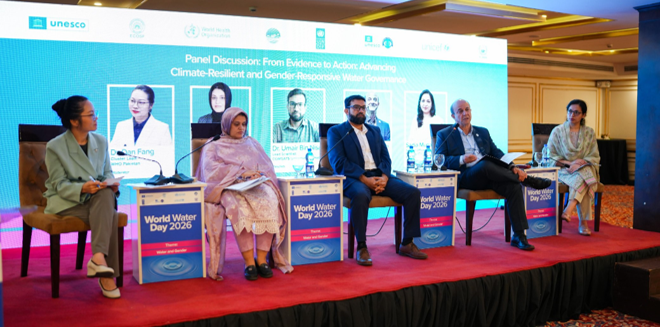
Prof. Seyed Komail Tayebi, President ECOSF, participated in the panel discussion titled “From Evidence to Action: Advancing Climate-Resilient and Gender-Responsive Water Governance.” The panel discussion was moderated by Dr. Dan Fang, Cluster Lead at WHO Pakistan. The panel brought together Dr. Hifza Rasheed, Director General of PCRWR; Dr. Umair Bin Nisar, Lead Scientist at COMSATS University Islamabad; Prof. Seyed Komail Tayebi, President ECOSF; and Ms. Sadia Munawar, Section Officer (Development), Ministry of Climate Change and Environmental Coordination. Prof. Tayebi highlighted that Pakistan and other ECO Member Countries face common challenges, including water scarcity, groundwater depletion, inefficient irrigation, water pollution, climate-induced floods and droughts, and dependence on shared water systems.
Prof. Tayebi emphasized that water governance must be grounded in scientific evidence, including reliable data, basin-level monitoring, groundwater mapping, climate projections, water-quality assessment, and research that informs practical policy and community-level action. He noted that countries with stronger human-resource development, research institutions, education systems, essential infrastructure, and economic resilience are better positioned to address climate and water risks and to enable meaningful participation by women in water-related decision-making. President ECOSF also offered valuable lessons and best practices in Iran, Türkiye and Central Asia on governance and resource efficiency in water management in the wider ECO region.